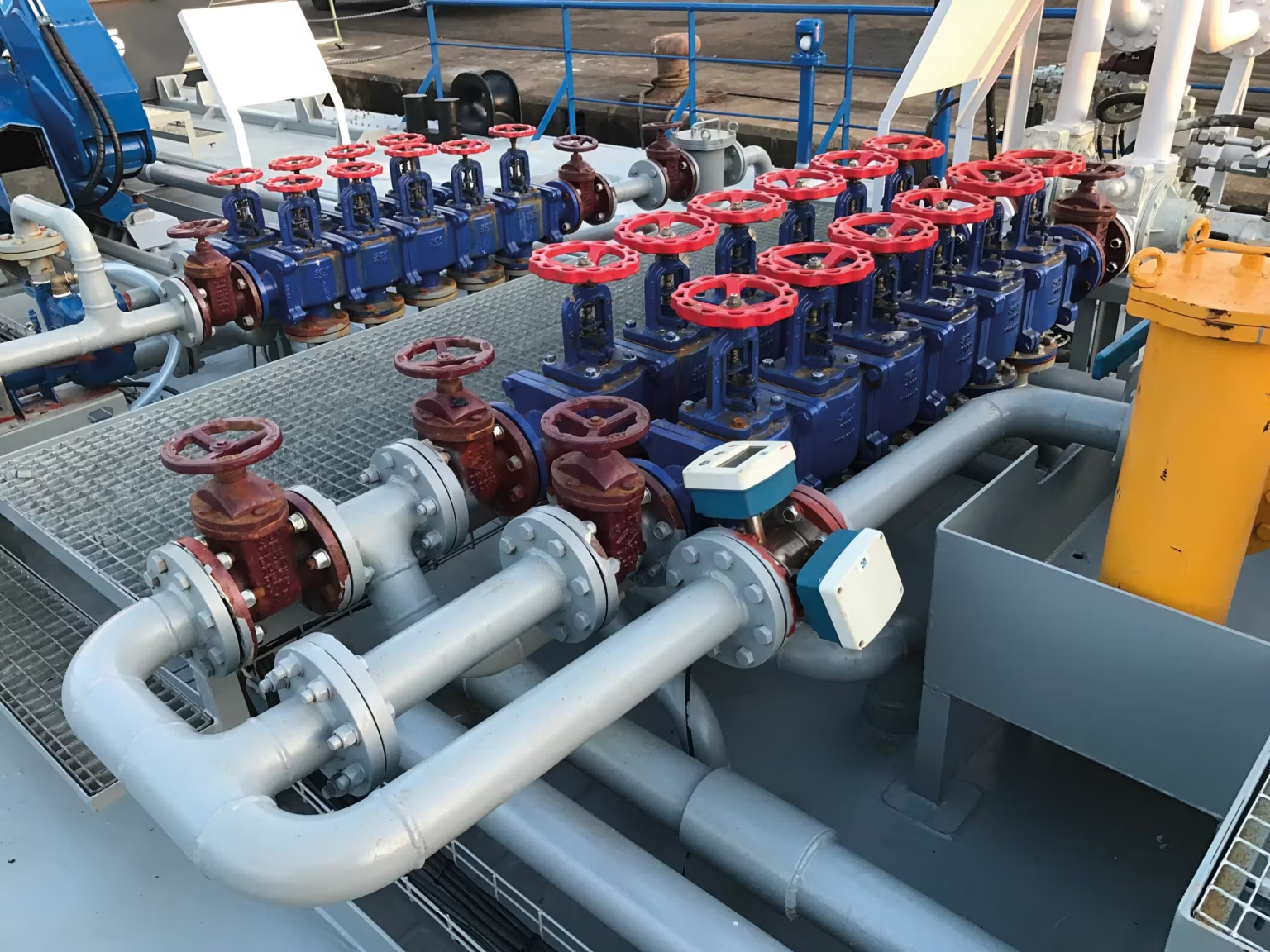
A vessel can sail with a dented hull plate. It can operate on a backup generator. But when a critical piping line fails — fuel, ballast, cooling, bilge — operations stop. And every hour of downtime counts against the bottom line.
Piping is arguably the most extensive and least visible system on any ship. Kilometres of lines running through tanks, bulkheads, engine rooms and decks, connecting every system that keeps the vessel running. When something fails in those lines, the problem rarely stays contained.
This article covers what’s involved in repairing and maintaining piping on board, which materials are used, how work is carried out to class standards, and how to plan these interventions so the vessel loses as little time as possible.
Ship Piping | Navi Mumbai , Alibag
What Ship Piping Is and Why It Matters
- Ship piping encompasses all pipelines, valves, fittings and supports that distribute fluids throughout the vessel. It is not a standalone system — it is the infrastructure that feeds and connects virtually every system on board.
- Key circuits that depend on piping include ballast and deballasting, seawater cooling for engines and auxiliaries, fuel oil supply lines from storage to main and auxiliary engines, bilge and oily water systems, hydraulic circuits for cranes, hatch covers and steering, steam lines for tank heating, and fresh water supply for domestic and technical use.
- Two factors make piping critical. First, its sheer extent: a medium-sized cargo vessel may have several kilometres of piping. Second, the operating conditions: these lines carry fluids at varying pressures, temperatures and levels of chemical aggressiveness. A leak in a fuel line and a leak in a freshwater line have very different consequences, but both can lead to operational downtime if not addressed properly.
Common Piping Failures on Board
Most piping failures don’t happen overnight. They develop over months or years and tend to surface at the worst possible time.
- Internal and external corrosion. – The most frequent cause of deterioration. Internal corrosion results from continuous contact with aggressive fluids — seawater, high-sulphur fuel, acidic condensates. External corrosion, often overlooked, stems from ambient humidity, missing coatings or water pooling from condensation. Bilge and ballast lines are particularly vulnerable.
- Erosion. – Lines carrying high-velocity fluids or fluids with suspended particles — such as unfiltered seawater — suffer progressive wall thinning, especially at bends, reducers and direction changes.
- Vibration fatigue. – Engines, propellers and the vessel’s own motion generate constant vibration. Over time, this causes micro-cracking at welds and connections, particularly in rigid lines with poor support or long unsupported spans.
- Joint, flange and valve failures. – Gaskets lose seal integrity, valves seize or fail to close properly, and flanges can deform from uneven tightening or galvanic corrosion between incompatible materials.
- Poor previous repairs. – It is not uncommon to find sections where earlier repairs used wrong materials, unqualified welding or no class documentation. These “emergency fixes” that never get properly rectified are a recurring source of problems.
- Carbon steel. – The most widely used material in ship piping. Found in ballast, bilge, fuel and low-pressure systems. Weldable with standard processes (SMAW, GMAW, FCAW), relatively inexpensive and readily available at any port. Its main weakness is corrosion: in contact with seawater or aggressive fluids, it requires internal coatings or sacrificial anodes.
- Stainless steel. – Used in lines requiring higher corrosion resistance or hygienic standards: potable water, sanitary systems, certain hydraulic lines and high-demand cooling circuits. More expensive, requiring welders qualified in TIG/GTAW, but offering significantly longer service life in aggressive environments.
- Copper-nickel (CuNi). – The reference material for seawater lines: cooling circuits, fire-fighting systems and ballast lines in exposed areas. The most common shipboard alloys are 90/10 and 70/30. Excellent marine corrosion resistance, but CuNi welding requires specific qualification, controlled atmosphere and class-validated procedures.
- Aluminium – Used in superstructures and aluminium-built vessels to maintain structural consistency and prevent galvanic corrosion. Also found in some ventilation lines and lightweight systems. Welding (typically TIG) requires extreme cleanliness and oxidation protection during the process.
The operational consequences are direct: leaks that contaminate tanks or bilges, auxiliary system shutdowns that reduce the vessel’s operating capacity, environmental non-compliance (especially on bilge and MARPOL lines), class findings that prevent sailing, and ultimately, off-hire.
Materials Used in Ship Piping
Material selection determines the line’s service life, the welding process required, the certifications needed and the cost and complexity of any repair.
What matters to the shipowner is that each material demands a different welding procedure, welders with specific class society qualifications, and traceable material certificates. A piping repair cannot be improvised with whatever is available in the stores: the filler material, the procedure and the welder’s qualification must match the system and be verifiable by the surveyor.